learnfinancewith

K–12 financial literacy · built on a simulated economy

For most students, high school is the last classroom they will ever sit in.

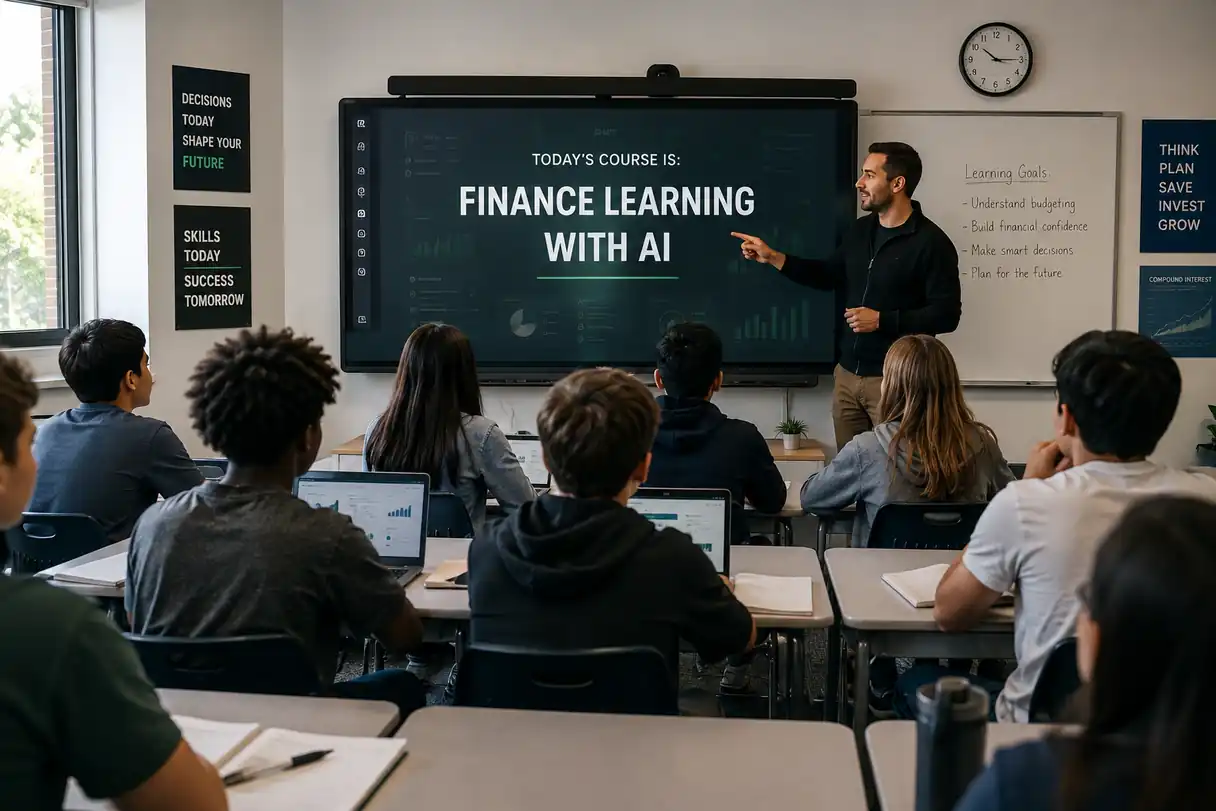
They leave it able to factor a quadratic and unable to read their own pay stub. learnfinancewith spends thirteen years closing that gap — one continuous simulated economy, from a second-grader’s first spend-or-save decision to a senior’s first loan.

Walk the demoSee the problem firstNo account · no real money · 10 personas

For schools and districts

Every school builds this its own way.

learnfinancewith is a platform, not a packaged course. A school stands it up for its own students, its own teachers and its own families — then teaches the thirteen years we wrote, or the year it writes itself.

As it ships

Teach the thirteen years we wrote

A full K–12 sequence, already written and already checked. Adopt it whole and the year is planned before the first bell — the arc, the order, and what each session is for.

  • Thirteen courses, kindergarten through twelfth grade
  • Every session carries an objective and a mapped standard
  • Reading level enforced per grade band as a build gate
  • A starting unit chosen for you, changeable any time
Made yours

Or run your own scope and sequence

Nothing forces our order. Choose the units, set the sequence, assign lesson by lesson, and teach the course your department already believes in — on our machinery instead of a photocopier.

  • Assign any session to any class, in any order
  • Your pacing, your emphasis, your term structure
  • Coverage still reports against the standards you owe
  • Mix a unit of ours into a course of yours

Either way, the same machinery runs underneath — which is why switching from ours to yours costs a term’s planning, not a migration.

  • The simulated economyOne continuous world from the first spend-or-save decision to the first loan.
  • Standards coverageGenerated from the assessment items, including the gaps.
  • Gradebook and live classNames and a verb, at the moment a teacher can still act on it.
  • The family viewRead-only, bilingual, about learning rather than balances.

State by state, this is now the law

Personal finance graduation requirements, mapped for all 50 states.

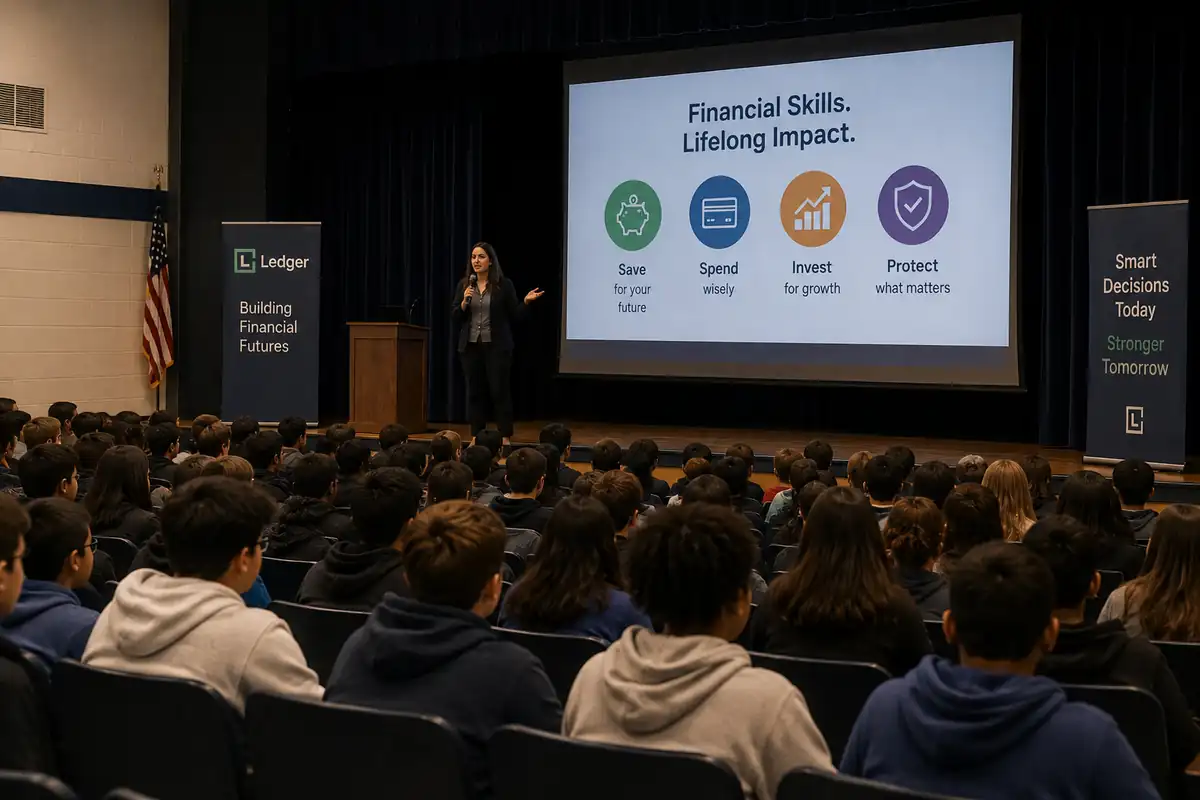
Most states now require personal finance to graduate — each with its own statute, credit value, deadline, and course codes. We track every one of them to primary sources, and every fact we have not verified yet says so instead of guessing.

29

states where the requirement is in force now

16

more where it binds a class still in school

50

states tracked, citation by citation

Find your state’s requirement

Statement of a graduating senior

The account nobody balances

On one side, what thirteen years of school covers, and for how long. On the other, what the world asks of a graduate inside ninety days. The difference is not a failure of effort — it is a line item nobody was ever assigned.

Taught, and for how long

  • 13 yrFactoring a quadratic
  • 13 yrAnalysing a sonnet
  • 4 yrBalancing a chemical equation
  • 4 yrCiting a primary source
  • 2 yrConjugating a second language

Asked for, within ninety days

  • 0 yrPick a checking account and avoid its fees
  • 0 yrRead a pay stub and find where the money went
  • 0 yrChoose a deductible without knowing what one is
  • 0 yrSign a loan with a term longer than they have been alive
  • 0 yrDecide what happens to the first real paycheck
BalanceCarried forward · unpaid

What actually changes

Not "students learn about money." Three specific things that are true at the end of a year with learnfinancewith and are not true at the end of a year without it.

A student who has already made the mistake — and paid for it in a room with an adult in it.

HowThey overdraft in year three, on simulated money, and it costs a fee and a conversation instead of a real fee and a habit. The simulation runs a full school year: paychecks land, bills come due, interest accrues, and a late payment follows them the way a late payment does.

A teacher who knows the eight students who need them — before the bell, not after the quiz.

HowThe teacher’s screen opens with names and a verb — "Sit with Andre and walk one overdraft back through the ledger" — with the evidence underneath it. No dashboard to interpret between passing periods.

A board that can see which standards have nothing behind them.

HowMost coverage reports print "12 standards covered". Ours prints the gap column — the standards with no assessment item attached — because that is the number a district needs in order to ask for the right thing.

One economy, thirteen years, three skins

The same simulated world the whole way through. What changes is what a student is trusted to touch, and how much the screen explains before it asks.

K–2
Explorer

Spend it or save it.

One decision per card, read aloud on request. Two tap targets, no typing, and feedback that explains instead of scolding.

3–5
Saver

Where money comes from.

Work, gifts, and interest as three different origins. A first one-week budget that has to survive an unplanned expense.

6–8
Earner

A first paycheck, and books to keep.

Gross versus net on a real pay stub. A micro-business whose single-entry ledger reconciles to the double-entry one to the cent. An emergency fund that gets tested.

9–12
Builder

Credit, insurance, taxes, a portfolio.

A credit model that moves and explains why. A bookkeeping capstone and a proctored final built from a published blueprint.

This course is designed to support articulation and dual-enrollment agreements. College credit is awarded solely by the partnering institution, at its discretion, under its own policies. Completing this course does not by itself grant college credit.

The last thing we do is tell you to leave.

Live in the demo · the family of Devon W.

learnfinancewith will never connect to a bank. No account numbers, no rails, no card issuance — that is a permanent design constraint, not a roadmap item.

What it does instead is watch the simulation for the moment a student is ready for the real thing. Then it tells the family — not a bank, not a lender, and never a partner who paid to be there.

To the family of Devon W.Grade 7 · May

This may be a good month to open a real account with Devon.

  • Held a budget for a full semester without an overdraft
  • Paid the bills that came due on time, nearly every time
  • Kept money set aside rather than spending down to nothing
  • Read a pay stub and found the deductions without help

What the minimum balance is · which fees can be waived · whether it is custodial and what changes at 18. No bank is named and none has paid to appear. We do not take referral fees.

Everyone at the table gets a different screen

Four audiences, four questions, four answers — each one built for the person asking it rather than reskinned from the teacher's view.

Teacher

Eight names and what to do about each, before first period. Fire a life event mid-lesson and watch a class react to it live.

Family

Progress, never a balance — a screenshot of a balance is the thing most likely to be mistaken for a real account. English or Spanish, from day one.

Principal

Adoption and standards coverage for one building, at the current week, without waiting on a district export.

Board and district

The coverage report with its gap column, an audit trail of every teacher intervention, and a privacy posture written to be forwarded to counsel.

What it refuses to do

Every item below is enforced in the build, not in a policy document. Several fail continuous integration if someone writes copy that contradicts them.

No real money

Every balance is denominated in a simulated in-world currency and labelled as simulated on every screen. No payment processing, no card issuance, no connection to a real bank account.

No webcam

The proctored final records that a tab lost focus or that text was pasted. No room scans, no eye tracking, no keystroke biometrics, and nothing to install on a device.

No trackers

First-party analytics only. No ad networks, no data brokers, no session recorders, no behavioural profiles, and student information is never sold.

No profile

Home address, date of birth, government identifier, race, disability status and biometrics are columns that do not exist in the database. A test inspects the schema on every change.

No overclaim

Designed for articulation and dual-enrollment partnerships. Credit is awarded solely by the partnering institution, at its discretion, under its own policies.

The demo is the argument

Pick a person and see exactly what they see.

Maple Grove USD is a fictional district with 130 seeded students and a full simulated school year already behind it. Tell us who you are and it opens — no account, no password, nothing real inside. A two-minute guided walk first, then take a seat: a second-grader, a teacher between passing periods, or the district administrator presenting to a board on Tuesday.